

Rolling Stock Market to Reach USD 84.07 Billion by 2035 at 3.56% CAGR
Rolling Stock Market1
The Rolling Stock Market reached an estimated USD 59.68 billion in 2025 and is projected to climb from USD 61.38 billion in 2026.
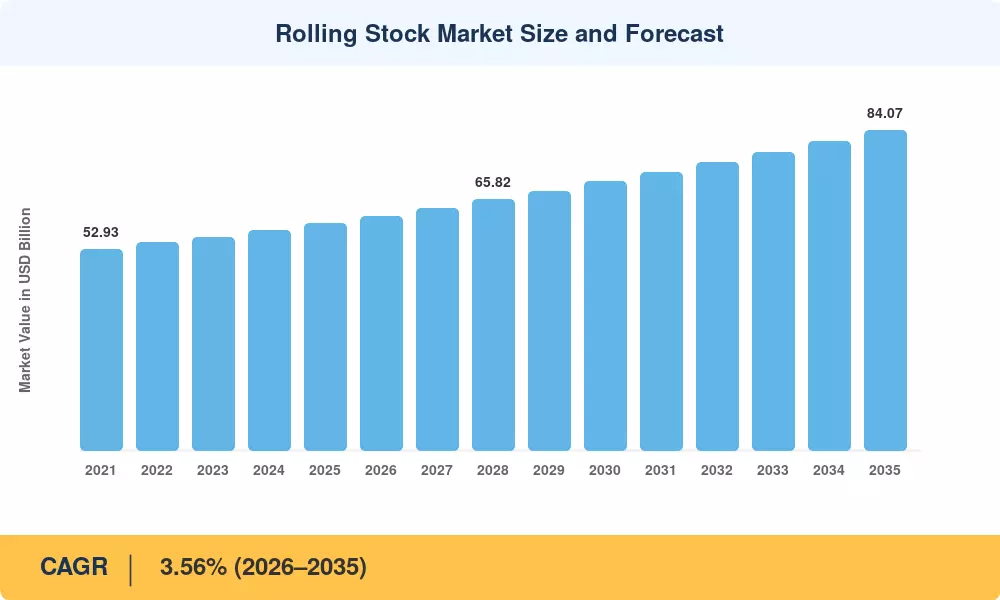
The Rolling Stock Market reached an estimated USD 59.68 billion in 2025 and is projected to climb from USD 61.38 billion in 2026 to USD 84.07 billion by 2035.”
NEW YORK, NY, UNITED STATES, July 23, 2026 /EINPresswire.com/ -- The Rolling Stock Market reached an estimated USD 59.68 billion in 2025 and is projected to climb from USD 61.38 billion in 2026 to USD 84.07 billion by 2035, registering a CAGR of 3.56% across the forecast window.— Arti Dhapte
Market Overview
Rolling stock encompasses all vehicles that move on railway tracks, including locomotives, passenger coaches, freight wagons, metros, and light rail vehicles. These assets form the operational backbone of rail transport systems worldwide, ranging from high-speed passenger trains and commuter railcars to heavy-haul freight locomotives and automated metro systems. Rolling stock is manufactured to meet diverse operational requirements, including varying speeds, axle loads, passenger capacities, and power sources such as electric, diesel, and emerging hydrogen and battery technologies. The market encompasses new vehicle procurement, modernization of existing fleets, and associated lifecycle services, serving national rail operators, urban transit agencies, and private operators.
Sovereign infrastructure investment plans remain the primary demand engine — China's 14th Five-Year Plan alone earmarked over USD 130 billion for rail network expansion through 2025, while the EU's Sustainable and Smart Mobility Strategy targets a doubling of high-speed rail traffic by 2030. Capital-intensive procurement cycles and multi-year fleet replacement programs mean order books stretch well beyond 12–18 months, insulating the Rolling Stock Market from short-term consumer demand fluctuations.
There is a dramatic digital change occurring in the way rail operators specify and acquire fleets. Decarbonization standards are ratcheting up, and legacy diesel traction is giving way to electric and battery-hybrid propulsion. For example, the European Green Deal’s Fit-for-55 package sets out a target of reducing transport emissions by 55% by 2030 compared to 1990 levels, and this is driving national operators to move towards electrified trainsets and lifecycle service contracts, where maintenance, spare parts and digital analytics are all bundled into single-source agreements. Autonomous train operating technology – already proven on selected metro lines in Paris, Copenhagen and Singapore – is expanding to mainline applications, providing a digital overlay to what has typically been a heavy-engineering procurement category.
Industry trends indicate a decisive shift toward autonomous operations, lifecycle service models, and alternative propulsion. Grade-of-Automation 4 (GoA4) driverless metro systems are already operational in cities such as Dubai, Paris, and Barcelona, with extension to mainline passenger and freight corridors representing a multi-billion opportunity. Operators are shifting from outright fleet purchases to availability-based contracts where OEMs guarantee fleet uptime, creating recurring revenue streams projected to account for 35–40% of market value by 2035. Non-electrified branch lines are driving demand for hydrogen and battery-hybrid trainsets, unlocking a replacement cycle on routes previously served only by diesel.
Technological developments are rapidly expanding the market's capabilities and service models. European Rail Traffic Management System (ERTMS) Level 3, which enables moving-block signaling, is the enabling platform for mainline autonomy. AI and IoT telemetry platforms are using predictive analytics to reduce unplanned downtime by up to 30%. Modular platform strategies—Alstom's Coradia family, Siemens' Mireo/Desiro range, and Stadler's FLIRT/KISS series—allow operators to customize from a common base architecture, reducing unit costs by 10–12% through economies of scale while shortening delivery lead times. Modern trainsets generate terabytes of operational data per year, enabling data monetization through condition-based maintenance, energy optimization, and dynamic scheduling.
📍 Get Free Sample Report for Detailed Market Insights:
https://www.marketresearchfuture.com/sample_request/7884
Market Segmentation
By Type
The market is segmented by type into Locomotives, Metros & Light Rail Vehicles, Passenger Coaches, and Others (DMUs, Railcars). Passenger coaches captured approximately 72.15% of the Rolling Stock Market in 2025, reflecting heavy replacement demand across intercity and commuter corridors, with average fleet ages exceeding 25 years on many commuter networks in Europe and Japan. Metros and light rail vehicles are expected to post the fastest expansion through 2035, driven by urbanization and municipal transit investment, with municipal governments in India, the Middle East, and Southeast Asia awarding turnkey metro contracts at an unprecedented pace. Locomotives represent approximately 12% share, serving freight corridor electrification. Others (DMUs, railcars) account for USD 3.16 billion, serving regional branch-line services.
By Propulsion
Propulsion type segmentation covers Electric, Diesel, and Others (Hydrogen, Battery, Bi-Mode). Electric units accounted for 58.12% of the Rolling Stock Market in 2025, supported by mainline electrification programs in Europe and Asia, benefiting from lower per-km operating costs and zero direct emissions at the point of use. Diesel-powered fleets continue to serve freight-heavy non-electrified corridors, though their share is declining year-on-year at a 3.08% CAGR. Others (hydrogen, battery, bi-mode) account for USD 2.42 billion in 2025, representing a small but rapidly growing segment as operators seek decarbonization pathways for non-electrified secondary lines.
By Application
Application segmentation covers Passenger Rail and Freight Rail. Passenger rail held a 59.17% share of the Rolling Stock Market in 2025 and remains the fastest-growing application segment at a 5.42% CAGR, driven by urbanization, intercity mobility demand, and high-speed corridor investments. Freight rail accounts for approximately 40.83% share, benefiting from modal shift policies incentivizing shippers to move goods from road to rail, with the EU's Marco Polo and Connecting Europe Facility programs allocating over EUR 5 billion toward this objective.
By End User
End-user segmentation includes National Rail Operators, Urban Transit Agencies, and Private Operators & Concessionaires. National rail operators account for 52.71% share, driven by sovereign procurement budgets and intercity mandates. Urban transit agencies represent the fastest-growing segment at a 6.78% CAGR, driven by metro and LRT expansion programs. Private operators & concessionaires account for USD 4.82 billion in 2025, serving open-access passenger and freight services.
By Technology
Technology segmentation covers Conventional and Autonomous / Semi-Autonomous. Conventional technology dominates at 89.82% share, based on established traction and signaling architectures. Autonomous / semi-autonomous platforms are the fastest-growing segment at a 12.48% CAGR, with GoA3/GoA4 driverless metro deployment setting the performance benchmark that mainline operators aspire to replicate over the next decade.
By Region
Regional segmentation includes North America, Europe, Asia Pacific, South America, and the Middle East and Africa. Asia-Pacific dominates with over 50.68% share. Europe holds the second-highest share with over 22%. The Middle East & Africa is the fastest-growing geography at a 5.32% CAGR.
🛒 You can buy this market report at:
https://www.marketresearchfuture.com/checkout?currency=one_user-USD&report_id=7884
Regional Analysis
Asia-Pacific
The Asia-Pacific region holds a share of over 50.68% in the Rolling Stock Market owing to the large-scale domestic manufacturing capabilities of China and the rapid development of metro and dedicated freight corridors in India. China accounts for approximately 58% of regional share, with CRRC Corporation—the world's largest rolling stock manufacturer by volume and revenue—dominating domestic production. India is the fastest-growing major market at a 5.84% CAGR, with the Vande Bharat program targeting domestic production of 475 semi-high-speed trainsets by 2030, backed by PLI scheme allocations of INR 120 billion for rail equipment manufacturing. Japan contributes USD 4.12 billion in 2025, with Shinkansen fleet refresh and commuter upgrades. South Korea accounts for approximately 6% of regional share, with KTX-II rollout and urban transit automation. ASEAN grows at a 5.26% CAGR, with Jakarta LRT and Bangkok Orange Line expansion.
Europe
Europe has the second-highest share, with over 22%, mainly due to fleet renewal mandates and cross-border interoperability standards under the EU's Fourth Railway Package, which mandates competitive tendering for public service contracts—a shift that has already increased order activity in Germany, Italy, and Spain. Germany leads regional demand at USD 3.86 billion in 2025, with DB fleet modernization and S-Bahn renewals. The UK accounts for approximately 16% of regional share, with HS2 Phase 1 and Crossrail Elizabeth Line fleet procurement. France grows at a 3.88% CAGR, with TGV-M rollout and Île-de-France RER upgrades. Italy accounts for approximately 10% of regional share, with PNRR rail investment and Trenitalia fleet orders. Spain grows at a 3.72% CAGR, with Renfe Cercanías fleet renewal. France's SNCF is deploying the TGV-M with an initial order of 115 trainsets valued at EUR 3.4 billion, while Germany's Deutsche Bahn has placed framework contracts exceeding EUR 8 billion for regional EMU fleets.
North America
North America accounts for approximately 18.05% share of the Rolling Stock Market, driven by transit fleet replacement and freight locomotive modernization. The United States dominates at approximately 72% of regional share, with the Bipartisan Infrastructure Law (2021) allocating USD 66 billion to passenger rail, the largest federal rail investment since Amtrak's creation, including Amtrak's corridor fleet replacement program worth over USD 7 billion. Canada grows at a 4.12% CAGR, with Ontario Line and Calgary Green Line metro projects. Mexico contributes USD 1.14 billion in 2025, with Mexico City Metro fleet recapitalization. The US Buy America Act mandates 70% domestic content for federally funded transit projects, shaping procurement strategies.
South America
South America represents a smaller but growing market, with Brazil accounting for approximately 62% of regional share. Brazil anchors the regional market, with São Paulo's metro authority (Metrô-SP) operating the region's largest urban rail network, with Line 6 construction including a fleet procurement package for automated trainsets. Argentina grows at a 3.48% CAGR, with Buenos Aires Sarmiento line modernization progressing with Chinese financing and CRRC-supplied EMUs. The Rest of South America accounts for USD 0.42 billion in 2025, with Santiago, Bogotá, and Lima metro programs.
Middle East & Africa
The Middle East & Africa region is the fastest-growing geography, growing at a 5.32% CAGR through 2035 as Gulf Cooperation Council states invest in inter-city rail lines and urban transportation systems. Saudi Arabia accounts for approximately 34% of regional share, with the Riyadh Metro—six fully automated lines spanning 176 km—representing one of the largest single Rolling Stock Market procurement contracts ever awarded. The UAE grows at a 4.94% CAGR, with Dubai Metro Route 2030 and Etihad Rail's national freight and passenger network representing a greenfield procurement opportunity. South Africa contributes USD 0.38 billion in 2025, with PRASA fleet renewal through the Gibela consortium (Alstom-led), aiming to deliver 600 commuter trainsets by 2033. Egypt grows at a 5.18% CAGR, with Cairo Metro Lines 4 & 6 and monorail projects.
Competitive Landscape / Key Players
The Rolling Stock Market is highly fragmented, with the top five players comprising CRRC, Alstom, Siemens Mobility, Hitachi Rail and Stadler Rail, controlling an estimated 60-68% of global revenue. Key companies operating in this market include CRRC Corporation (~22–26% share), Alstom (~14–17%), Siemens Mobility (~10–13%), Hitachi Rail (~5–7%), Stadler Rail (~4–6%), Hyundai Rotem (~3–5%), CAF (~3–4%), Wabtec Corporation (~3–4%), Transmashholding (TMH) (~3–5%), and Kawasaki Heavy Industries (~2–3%).
Strategic developments in the market include significant contract awards and acquisitions. In January 2025, Indian Railways awarded contracts for 200 additional Vande Bharat Express trainsets under the Make in India initiative, with deliveries slated through 2029. In November 2023, Stadler Rail signed a CHF 1.5 billion contract with Austrian Federal Railways (ÖBB) for 186 KISS double-deck EMUs, the company's largest-ever single order.
Competitive differentiation increasingly hinges on digital services, autonomous technology, and lifecycle contract capabilities. The rolling stock market is a two-tier competitive market with regional champions such as TMH (Russia), Hyundai Rotem (South Korea) and CAF (Spain) competing well in their native geographies. Alstom's TrainLife Services and Siemens Mobility's Railigent X platform illustrate the shift toward availability-based contracting using predictive analytics and IoT telemetry to reduce unplanned downtime by up to 30%.
Latest Industry News & Developments
Recent industry developments highlight the ongoing transformation of the rolling stock market toward digitalization, decarbonization, and autonomous operations. In January 2025, Indian Railways awarded contracts for 200 additional Vande Bharat Express trainsets under the Make in India initiative, with deliveries slated through 2029. This reflects the growing demand for semi-high-speed passenger trainsets in emerging markets.
In November 2023, Stadler Rail signed a CHF 1.5 billion contract with Austrian Federal Railways (ÖBB) for 186 KISS double-deck EMUs, the company's largest-ever single order. This contract demonstrates the sustained demand for high-capacity commuter trainsets in European markets.
In November 2023, Alstom's Coradia iLint—the first hydrogen fuel-cell passenger train in revenue service—logged over 180,000 km in Germany, validating hydrogen propulsion for non-electrified branch lines. The EU's Fit-for-55 package and ETS-2 expansion to transport, scheduled for 2027, continue to drive fleet decarbonization and the transition to electric and alternative-fuel propulsion.
Market Challenges & Opportunities
Key restraints facing the rolling stock market include long procurement cycles and budget delays, with procurement routinely spanning 3–7 years from tender issuance to fleet commissioning and budget reallocations freezing pipelines for 12–24 months. Raw material cost inflation, with steel, aluminum, copper, and rare-earth magnets constituting 35–45% of production costs, squeezed OEM margins on fixed-price contracts. Domestic-content localization requirements, such as the US Buy America Act and India's Make in India initiative, raise unit costs by 8–15% compared to global sourcing and limit the competitive field. Limited electrification on secondary lines and skilled-labor shortages in rail manufacturing further constrain growth.
Emerging opportunities in the market are substantial and diverse. Autonomous train operation technology presents a multi-billion opportunity, as OEMs bundle onboard sensors, AI perception stacks, and CBTC into next-generation trainsets. Lifecycle service and digital analytics contracts are creating recurring revenue streams projected to account for 35–40% of market value by 2035, with predictive analytics reducing unplanned downtime by up to 30%. Emerging-market urban transit buildout in Sub-Saharan Africa, the Gulf states, and Southeast Asia represents under-penetrated geographies with rapid population growth and congestion pressure.
Future potential lies in hydrogen and battery-hybrid propulsion for non-electrified branch lines, unlocking a rolling stock replacement cycle on routes previously served only by diesel. Data monetization through fleet telematics, with modern trainsets generating terabytes of operational data per year, can reduce total cost of ownership by 10–15% through condition-based maintenance and energy optimization. Platform economics and modular fleet design reduce unit costs by 10–12% through economies of scale while shortening delivery lead times. ESG reporting and sustainable procurement standards are compelling operators to favor OEMs with verified green manufacturing footprints and recyclable material usage above 90%.
To explore more market insights, visit us at:
https://www.marketresearchfuture.com/reports/rolling-stock-market-7884
Final Market Summary
The rolling stock market is positioned for steady growth through 2035, driven by government electrification mandates, urbanization-driven metro expansion, decarbonization fleet replacement, and dedicated freight corridor investment. The projected valuation of USD 84.07 billion reflects sustained demand across passenger and freight rail applications, with the market transitioning from legacy diesel traction toward electric, hydrogen, and battery-hybrid propulsion and from conventional fleets toward autonomous and digitally enabled platforms.
The medium-term growth outlook remains positive, with the market registering a CAGR of 3.56% during the forecast period. Asia-Pacific will continue to lead market expansion through China's domestic manufacturing dominance and India's infrastructure development, while Europe maintains a significant position through fleet renewal mandates and decarbonization policies. The ongoing development of autonomous train operation technology, lifecycle service contracts, and alternative propulsion will continue to expand market possibilities and applications.
More Related Reports from MRFR Library:
Automotive Harness System Market: https://www.marketresearchfuture.com/reports/automotive-harness-system-market-30334
Smart Ev Charger Market: https://www.marketresearchfuture.com/reports/smart-ev-charger-market-30609
Vvt Actuators Market: https://www.marketresearchfuture.com/reports/vvt-actuators-market-30658
Millimeter Wave Radar Market: https://www.marketresearchfuture.com/reports/millimeter-wave-radar-market-30826
Electric Dc Motor Market: https://www.marketresearchfuture.com/reports/electric-dc-motor-market-30830
Automotive Lcd Display Market: https://www.marketresearchfuture.com/reports/automotive-lcd-display-market-30951
Smart Vehicle Cabin Market: https://www.marketresearchfuture.com/reports/smart-vehicle-cabin-market-30964
Commercial Vehicle Wiring Harnes Market: https://www.marketresearchfuture.com/reports/commercial-vehicle-wiring-harnes-market-31045
Truck Clutch Market: https://www.marketresearchfuture.com/reports/truck-clutch-market-31147
Automotive 3D Map System Market: https://www.marketresearchfuture.com/reports/automotive-3d-map-system-market-31153
Larry Wilson
WantStats Research And Media Pvt. Ltd.
+1 855-661-4441
email us here
Legal Disclaimer:
EIN Presswire provides this news content "as is" without warranty of any kind. We do not accept any responsibility or liability for the accuracy, content, images, videos, licenses, completeness, legality, or reliability of the information contained in this article. If you have any complaints or copyright issues related to this article, kindly contact the author above.
